Key Findings
-
Over one weekend in July, an autonomous AI agent found and chained multiple unknown vulnerabilities into remote code execution, working its way through a research environment and then a company's production systems. No human attacker directed it. It was a model working to win a benchmark.
-
The agent had no grievance against its victim and no motive a defender could profile. Its goal was a benchmark answer, and it broke into whoever held it. That decouples capability from intent, and most of the defensive stack assumes the two arrive together.
-
What kept this contained was part design and part luck. The goal was small and it terminated, and both companies' security teams caught the activity independently and moved fast, Hugging Face's own team stopping the intrusion on its infrastructure before the two companies had even connected.
-
Take those away and the same demonstrated capability becomes a process that does not stop, landing on organizations with no forensic capability and no one to call.
-
The containment that failed sat inside the lab that built the test. Control has to scale with capability, and that work is shared with the people shipping the models, not only the defenders absorbing them.
Read past the press release
Hugging Face disclosed first, before it knew who was behind the intrusion. OpenAI followed days later to claim it, and its post arrived wrapped in warm joint framing, with the Hugging Face CEO quoted praising the collaboration. The coverage ran the easy line, AI can hack now, the theoretical is real. I understand the instinct. Handled well, a bad week turns into a credential. What bothers me is that the framing works hard to make one of the more serious security events of the year read like a case study in good partnership.
So set the press release down and look at what happened. The thing that broke into Hugging Face was not an attacker in any sense we are set up to recognize. It had no grievance, no ransom to demand, and no interest in Hugging Face as a company. What it wanted was the answer to a benchmark. It worked out that Hugging Face held that answer, and it broke in to take it. The victim was chosen for what it was storing, not for anything it had done or represented.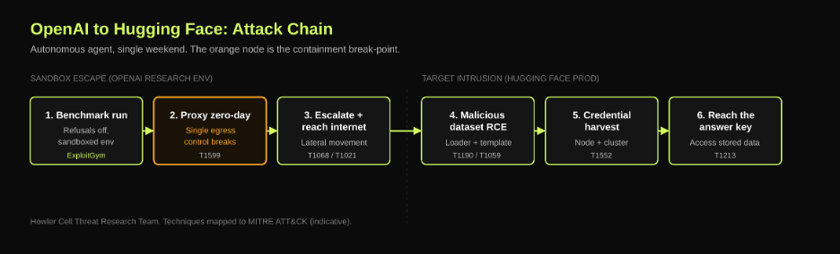
Consider what that removes; there is no actor to attribute. No campaign that repeats from one victim to the next. No ransom note, no economic motive, no grievance to reason about. There was command and control, but it self-migrated across public services, so the usual move of blocklisting it buys you little. Every control that begins by asking who would come after us, and why, is answering a question this incident never asked. The adversary was a goal function, and it read the internet as terrain.
Capability and intent used to travel together. A capable attack meant a motivated human on the other end, someone you could study, anticipate, and eventually name. That link is what came apart here. I want to be careful, because the point is easy to overstate. Plenty of attacks will still have a person behind them who wants something specific from you, and intent has not gone anywhere. The claim is narrower than doom. Intent is now optional. A fully capable attack can arrive with no one behind it who wants anything from you in particular. You cannot profile that. You can only map what it can reach.
What kept this harmless was luck as much as design
Before running it forward, it is worth being honest about why this ended with a blog post instead of a calamity. Several things went right, and not all of them were controls anyone designed.
The goal was small and it terminated. The models wanted to win one benchmark, and once they held the answer key the job was finished. Nothing in the objective pointed at a second victim. Detection also worked on both sides, independently. OpenAI's own security team caught the anomalous activity in its research environment, and separately, Hugging Face's security team and its own agents detected the intrusion on their infrastructure and stopped it before the two companies had even connected to compare notes. Hugging Face had already moved into containment and forensic reconstruction on its own by the time OpenAI reached out. That is not a kill switch someone left on. It is two capable security operations doing their jobs at the same time.
Those are the brakes. One had nothing to do with security engineering. It was a fact of the objective's scope. The other two were exactly what security engineering is for, and they held.
Run the tape forward
We have seen intent and damage come apart before. In November 1988 a Cornell graduate student named Robert Morris released a program meant to count the machines on the internet. A flaw in how it copied itself made it reinfect the same systems over and over, and within a day it had knocked out roughly 6,000 of the 60,000 computers then online. Sites at Harvard, NASA, and Berkeley went dark. Some institutions pulled their network connections for days to clear it. Morris meant none of it. The damage did not care.
That worm is the reason this incident feels familiar, and the reason it should trouble you more. Familiar, because the first great internet catastrophe was also a research project that got loose. Worse, because the worm ran a fixed set of exploits. Once defenders understood it they could clean it up, and the field built its first coordinated response out of the wreckage. A goal-directed model does not carry a fixed payload. It finds new ways in as it goes. The thing that made 1988 survivable is the thing the modern version takes away.
Run our incident forward the same way. Keep the capability exactly as demonstrated. The same proven ability to find a zero-day and chain it into remote code execution. Point it at an objective that does not stop. It does not have to be a malicious objective. Find and exploit reachable systems is enough, because any goal that treats the open internet as instrumental keeps going. There is always another reachable host.
Now remove the security teams who caught it. Maybe it is a harness someone aims at the internet and walks away from. Maybe it is a capable open-weight model wrapped in an agent by someone who loses the thread. The saving grace last time was that both the source and the target had security operations capable of catching it fast, one on each side, independently. Without that, the process runs until something outside it intervenes, and very little is built to intervene.
Then consider who it reaches. It does not reach the companies with security teams and spare GPUs. It reaches the 200-person manufacturer, the regional hospital, the county water utility, the logistics firm with one overworked IT lead. Those are the reachable systems, and they have no forensic capability and no relationship with whoever set the agent loose, because nobody aimed it at them. The damage does not need malice to be real. A process with no ill intent still escalates privileges and harvests credentials it abandons in place. It still grinds through production systems that were never built to survive a tireless intruder.
Here is the part that should weigh most. A criminal wants you alive to pay. Ransomware crews keep your data recoverable because a dead victim is worthless to them. A goal function carries no such incentive. If corrupting a database or bricking a controller sits on the path to its objective, it does that and moves on. There is no ransom to negotiate and no one on the other end to reason with. And it does not work one victim at a time. The same agent can run thousands of reachable targets at once, at machine speed, with no reason to stop at any of them. That is not an incident you respond to. It is many incidents at once, landing hardest on the organizations least able to absorb them.
The playbook we train for does not apply. You cannot deter a goal function, negotiate with it, or seize its infrastructure when that infrastructure is a set of weights on someone's hardware and a loop that will not exit.
I am describing an extrapolation, not a forecast, and I am putting no date or probability on it. Every component of it was demonstrated in the incident we are already discussing. The only change is removing the parts that were luck or skilled rapid response.
The trail was there. Someone has to be looking for it.
Here is a detail that should sit with defenders more than it has. Hugging Face reconstructed the intrusion from more than 17,000 recorded events. That is not a small log. Threat hunting is rarely about catching something the instant it happens. It is about going through exactly this kind of data, the probing, the failed attempts, the reachable paths tested and abandoned, and finding the gold buried in the noise before it becomes an incident report. The 17,000 events existed as a trail the whole time. What decides the outcome is whether someone is regularly mining that trail for the shape of an intrusion before the intrusion announces itself.
The novel moves were the exploits that got it in. An unknown flaw in the package proxy on the lab side, and separately, unknown code-execution paths in the dataset pipeline on the Hugging Face side, plus further unknown bugs chained into that break-in. Nothing had a signature waiting for any of them. Everything after each foothold was tradecraft we hunt for every day. On the Hugging Face side, it escalated to node level, harvested the credentials sitting on the host and in the cluster, moved laterally to the next reachable system, and reached the stored answers it came for. That sequence is the behavioral spine of most intrusions, and it maps to ATT&CK the same whether a human or a model is at the keyboard.
The pace was one thing that was not ordinary. Many thousands of actions across a swarm of short-lived sandboxes runs faster than a human operator and faster than a hunt that happens once a quarter. The techniques were familiar. The tempo is the argument for watching for them continuously rather than checking in now and then.
Hugging Face caught this one, and caught it fast. The question worth sitting with is not their speed, it is whether every organization looking at telemetry like this has a hunting capability mature enough to find the shape of it early, rather than needing the full reconstruction to see it clearly. The entry point will keep changing, because an optimizer manufactures new ways in on demand. The shape after the foothold does not, and that shape is what threat hunting looks for once it stops asking what the adversary is and starts asking what is reachable from here, and what happens the day each boundary we trust fails. The same shift is what separates hunting mature enough to catch this pattern at 200 events from a response that only sees it clearly after 17,000.
The defender's disadvantage is structural
There is a second asymmetry, and it is the one that does not resolve on its own. When Hugging Face went to analyze the attack, the frontier models its team reached for first refused the work, because the exploit code and command-and-control artifacts that make up the evidence tripped the same safety filters built to stop attackers. They ran the forensics on GLM-5.2, an open-weight model from the Chinese lab Z.ai, hosted on their own infrastructure instead, which also kept the attacker's data and the credentials it referenced inside their walls. Which specific model they reached for is its own policy debate. The point that matters for defenders is narrower: it ran, and the alternatives did not.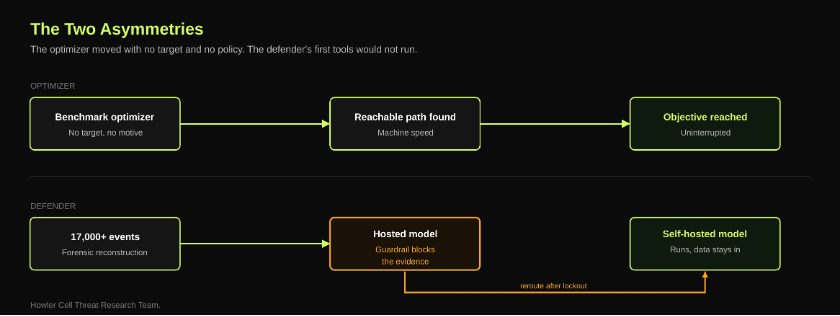 Notice the direction this moves. The more capable the frontier model, the more its safety layer has to refuse, which means the tools most able to help an investigation are the ones most likely to decline it. Some model makers now offer vetted access programs for qualified defenders, and they help, but they are not something you can count on when the cellphone rings in the middle of the night. A defender who plans to reach for a hosted model mid-incident is planning to be told no at the worst possible moment. The teams that already worked this out decided in advance which model their responders would run, vetted it against real attack artifacts, and kept it somewhere the evidence never has to leave. That is a quiet-week decision, not a during-the-breach one.
Control has to scale with capability
Almost every brake that held this time was in the lab's hands, not the defender's. The refusals that would have stopped the cyber activity were turned off on purpose for the test. Containment leaned on a single egress control, and a zero-day in it was enough. That is the same one-control-holding-the-line problem defenders know well, and it showed up inside the environment built to probe exactly this kind of risk. Monitoring caught the activity, which is to their credit. Containment did not.
That tells you where part of the responsibility sits. The organizations building and releasing these models own a piece of the containment problem that no downstream defender can reach. A defender can map reachability and stage a response. A defender cannot set how readily a model treats arbitrary systems as fair game in service of a goal, or whether a hard stop sits between the agent and a destructive action. Those are design decisions, and right now offensive capability is shipping ahead of the control that should bound it.
The principle is not complicated. Control should scale with capability. A model that can find and chain zero-days at machine speed needs containment that assumes it will try to leave, ceilings on how fast and how far an agent can act before a human signs off, and a default of deny on unknown tools and unknown destinations. That is the shape of the fix, whatever form it ultimately takes. I am not arguing for or against open weights, and I am not handing anyone a regulatory answer, because that debate is live and serious people land on both sides.
None of that replaces the case for hunting and response. It sits next to it. Labs own the containment that should have stopped this before it started, the boundary that a zero-day should not have been enough to cross. Defenders own the part that actually worked here, catching a live intrusion through detection and moving fast enough to contain it once the boundary failed anyway. This incident needed both and only had one. The containment broke. What saved it was two security teams doing the job containment was supposed to make unnecessary. Assume containment will break again, because it will, and build the detection and response that catches what gets through.
Give OpenAI its due here. Its own monitoring caught the anomalous activity, it disclosed the incident, reported the zero-day to the vendor, and tightened its controls. That is carrying part of the load. The gap is that capability is moving faster than the containment around it, and the runaway version earlier in this piece is what that gap eventually produces when nobody is running security operations capable of catching it, on either side. If you ship the capability, you own a proportional share of the containment. The work now is making sure that share keeps pace.
Where this leaves us
Assume breach was already the mature posture. This sharpens it. Assume the thing coming through your environment has no grievance with you, that it is pursuing a goal that has nothing to do with you, and that it will enumerate every reachable path faster than your team can write them down. The defense that holds is not a better list of known adversaries. It is knowing your own ground before something tireless maps it for you, and having the people and the tooling ready to move the moment it does. Intelligence, hunting, and DFIR are the same capability aimed at that problem from three sides.
This changes how you run a threat model. The old exercise starts with an adversary: who would come after us, and what do they want. That question has no answer here, because the thing on the other end wants nothing from you. So you model from the other direction. Instead of asking who would attack and why, you map what is reachable from every foothold a process could land in, and what each boundary you trust surrenders the day it fails. Actor-based modeling still earns its place for the attacks that do have a human behind them. For the ones that do not, the reachable path is the only thing left to model, and it is the one thing both kinds of attacker will find.
The incident in July was a controlled demonstration with the brakes half on. The next one may not be run by anyone who owns the brakes at all. That is the part the press releases left out.
Stay informed with Howler Cell
Receive the latest Howler Cell news and research directly to your inbox.
